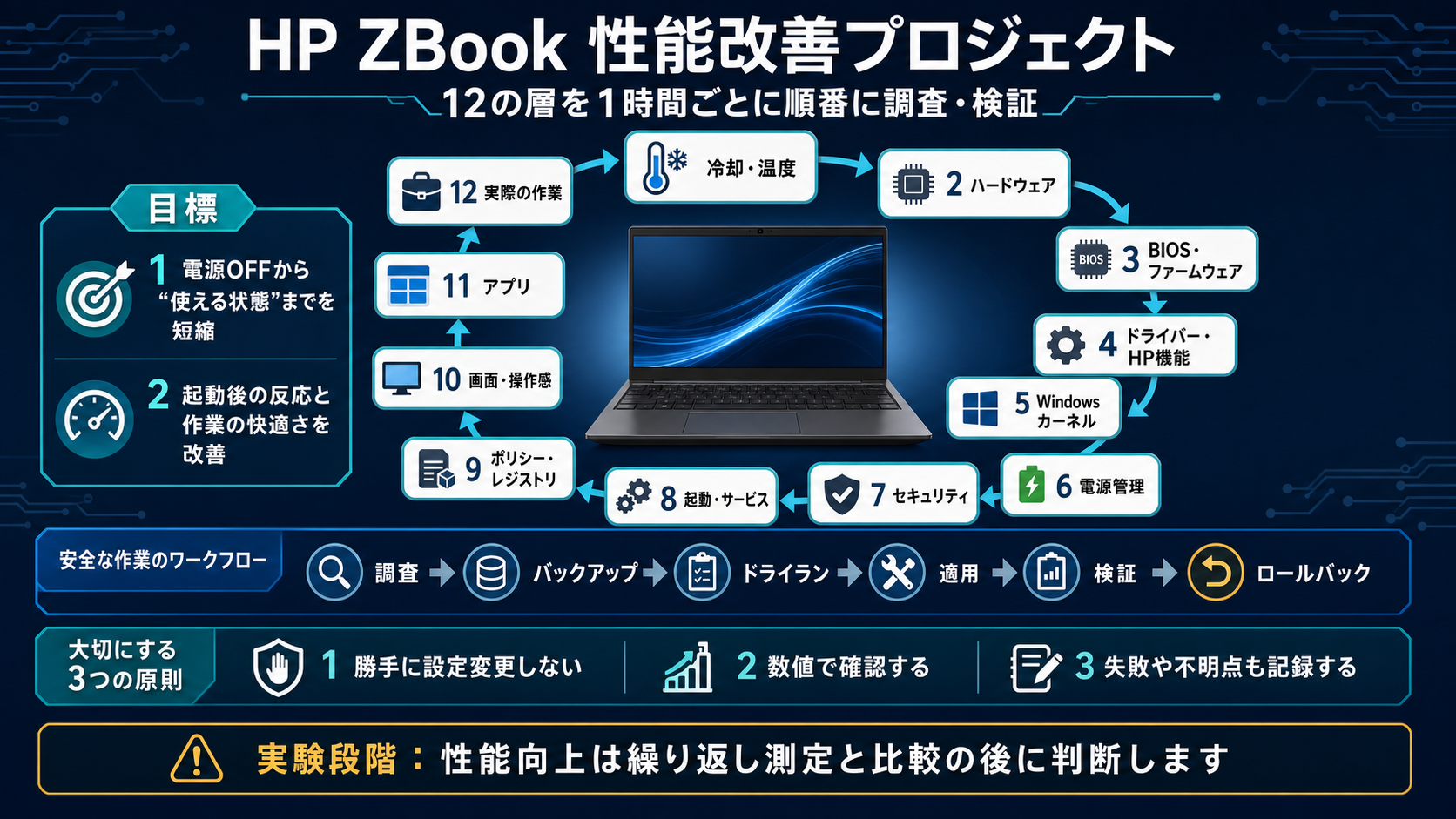
The twelve-layer cycle
- Physical and thermal health
- Hardware resources and bottlenecks
- BIOS, UEFI, embedded controller, and firmware
- Platform drivers and HP/OEM components
- Windows kernel, scheduling, memory, storage, and interrupts
- Power management and performance policy
- Security and isolation overhead without reducing protection
- Boot path, services, tasks, background permissions, and startup applications
- Group Policy, MDM-aware policy, registry, and system configuration
- Windows shell, GUI, capture, notifications, and perceived response
- Application/runtime efficiency and workload profiles
- Workload data, storage locality, network dependencies, and reproducibility
The cycle position is stored in the source repository. A run records an implemented, research-only, rejected, inconclusive, or blocked outcome before advancing. That keeps negative evidence visible and prevents silent layer skipping.
Startup, drivers, policy, and background work
“Boot time” will be separated into firmware, Windows kernel and session initialization, sign-in, shell readiness, delayed background activity, and target-application readiness. A usable state requires the responsive shell, required devices and network, and the selected workflow—not merely a visible desktop.
Services, tasks, background permissions, and startup applications remain required until primary documentation, dependency analysis, and preserved boot-trace evidence support a safer delayed, triggered, disabled, or removed state. The project will not publish a generic debloat list.
Driver work prioritizes supported package versions and configuration, device power behavior, DPC/ISR evidence, and interactions among Windows, HP, Intel, and other vendors. Proprietary driver binaries will not be rebuilt without source, redistribution rights, signing, hardware support, build instructions, and a verified recovery path.
Group Policy research will distinguish documented policy from registry implementation details. Domain, Entra, MDM, update, security, recovery, and HP support controls remain protected.
Required safety controls
- Support detection and compatibility limits
- Original-state capture and a read-only dry run
- Apply, verification, and structured logging
- Idempotence and exact rollback verification
- Reboot-persistence testing when applicable
Hourly unattended runs can research and non-destructively test those mechanisms. They cannot silently change the live laptop, stop services, alter startup entries, install drivers, enable automatic sign-in, bypass UAC, reboot, or weaken security and updates.
Evidence ledger
Documented facts
- The repository requires capture, dry-run, verification, logging, idempotence, and rollback for every modification.
- EXP-001 requires repeated raw runs, medians, controlled conditions, overhead qualification, and its decision rule.
- The cycle configuration itself does not alter Windows.
Lab measurements
No startup or responsiveness measurement was made for this process update.
Hypotheses
- Separate boot phases may reveal delays hidden by total boot duration.
- Supported driver configuration and dependency-aware startup changes may improve response without removing required functions.
Unresolved questions
- Which trace markers best define shell-ready and application-ready?
- What overhead will boot instrumentation add?
- Which components are actually on the boot critical path?
- Which supported driver versions should enter controlled comparison?
YouTube briefing
Presenter: We are expanding the Lacksan ZBook project into a complete, repeatable performance-engineering cycle. Every hour, the automation advances through one of twelve layers—from cooling and firmware through drivers, Windows startup, policy, applications, and real work.
Startup will be measured from power-off to a declared usable state. Services and startup programs are treated as required until documentation, dependencies, and boot traces prove otherwise. Driver work follows supported vendor paths; proprietary binaries are not casually rebuilt.
Every proposed change still needs support detection, original-state capture, a dry run, verification, structured logs, idempotence, exact rollback, and reboot testing where applicable. Failed and inconclusive findings will be published alongside successful ones.
This announcement initializes the cycle at layer one—physical and thermal health. It contains no new benchmark and makes no performance claim.